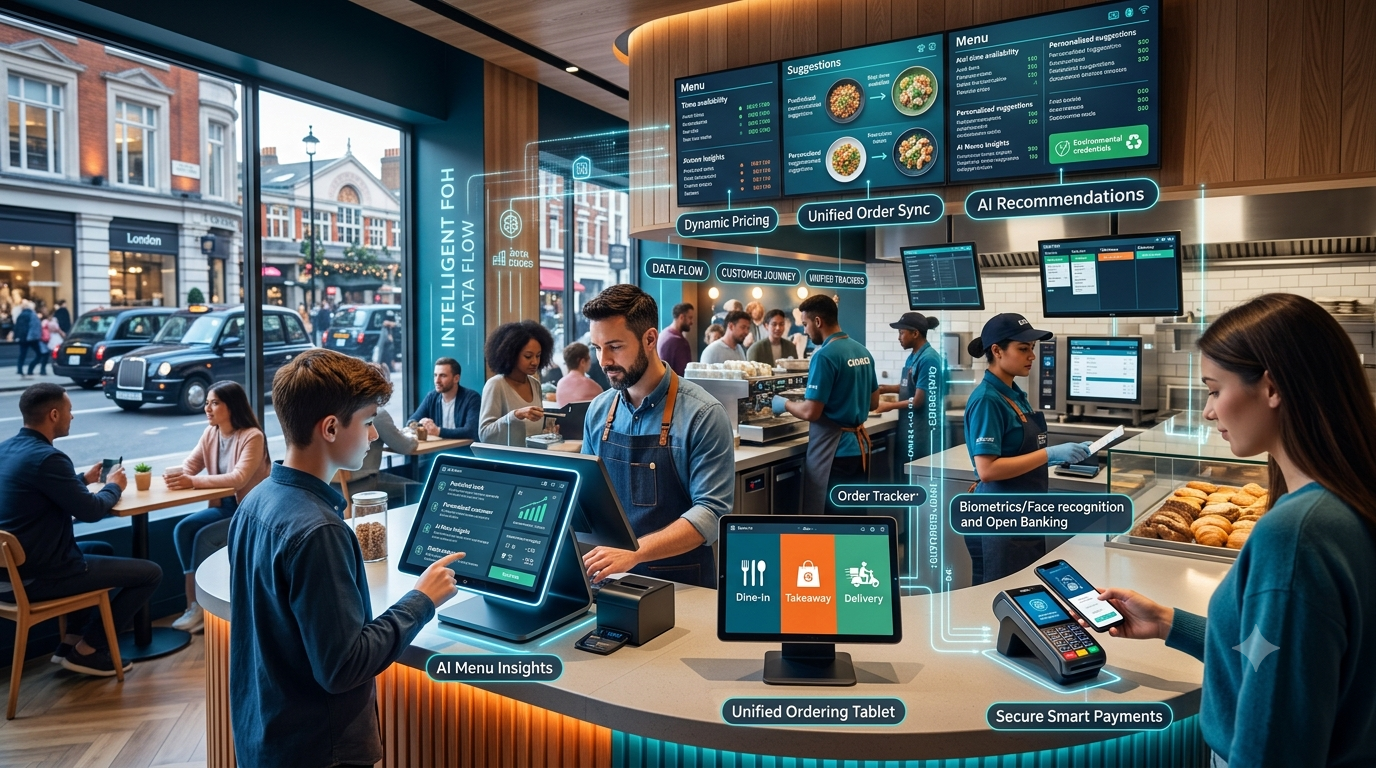
# Restaurant POS Trends in 2026: How AI, Unified Ordering and Smart Payments Are Changing UK Restaurants
## Introduction
The UK restaurant industry is entering a new phase of digital transformation in 2026. Restaurant technology is moving beyond basic billing and payment processing toward connected systems that help operators manage orders, payments, inventory, customer relationships, staff operations, and business intelligence from a single platform.
One of the biggest changes is the growing role of **AI in restaurant POS systems**. Modern POS platforms can increasingly turn transaction and operational data into forecasts, recommendations, and automated workflows. Industry coverage in 2026 highlights AI-driven forecasting, automated ordering, real-time decision support, and connected front- and back-of-house systems as major areas of development.
For restaurant chains and growing hospitality businesses, the question is no longer simply whether to use a POS system. The bigger question is whether the POS platform can become the technology hub for the entire restaurant operation.
## What Is Changing in Restaurant POS in 2026?
Restaurant POS systems are evolving from transaction terminals into integrated business platforms.
The latest trends include:
* AI-powered analytics
* Cloud-based POS
* QR code ordering
* Order-and-pay technology
* Tableside ordering
* Mobile and handheld POS
* Integrated payments
* Automated inventory management
* Customer loyalty and personalization
* Multi-location management
* Real-time business reporting
These technologies are being driven by rising operating costs, changing customer expectations, and the need for restaurants to improve efficiency without compromising the guest experience.
## 1. AI-Powered Restaurant POS
AI is becoming one of the most important developments in restaurant technology.
Rather than simply recording sales, modern systems can analyze historical and real-time information to help restaurant operators make better decisions.
Potential applications include:
* Sales forecasting
* Demand prediction
* Inventory forecasting
* Automated purchasing
* Staff scheduling
* Customer segmentation
* Menu performance analysis
* Personalized promotions
* Fraud detection
* Automated reporting
For example, a restaurant could combine historical sales, weather conditions, seasonal patterns, and other business information to estimate expected demand and prepare inventory and staffing accordingly.
AI is increasingly being positioned as a decision-support tool rather than a replacement for restaurant managers.
## 2. Unified POS and Restaurant Operations
One of the biggest trends in 2026 is the move toward connected restaurant technology.
Instead of operating separate systems for POS, ordering, payments, inventory, loyalty, delivery, and reporting, restaurants are looking for platforms that can connect these functions.
A modern restaurant technology ecosystem can look like:
**POS → Payments → Kitchen → Inventory → Customer Data → Loyalty → Analytics**
This creates a centralized flow of information and can reduce the problems caused by disconnected systems.
For restaurant chains, unified technology can also make it easier to manage menus, pricing, promotions, and operational information across multiple locations.
## 3. QR Code Ordering and Order-and-Pay
QR ordering continues to be an important part of restaurant technology in 2026.
Customers can scan a QR code at their table, browse the menu, place an order, and in some cases pay without waiting for a server to bring a bill.
This can be particularly useful for:
* Pubs
* Bars
* Food halls
* Casual dining
* Fast-casual restaurants
* High-volume venues
Modern QR ordering systems can also support upselling, customer data collection, and integration with POS and kitchen systems.
## 4. Tableside Ordering and Handheld POS
Handheld POS devices are becoming increasingly important for full-service restaurants.
Instead of servers writing orders down and returning to a fixed terminal, they can enter orders directly at the table.
Benefits can include:
* Faster order entry
* Fewer manual errors
* Faster communication with the kitchen
* Better table management
* Faster payment
* Improved service flow
The technology is not necessarily about replacing restaurant employees. Instead, it can remove repetitive administrative work and allow staff to spend more time interacting with customers.
## 5. Contactless and Mobile Payments
Payment expectations continue to change across the UK hospitality sector.
Modern restaurant POS platforms increasingly need to support fast and convenient payment experiences, including contactless and mobile payment options.
The UK’s payment infrastructure is also being developed with future account-to-account payment capabilities in mind, potentially creating additional payment choices at the point of sale.
For restaurants, the key requirement is to create a payment experience that is secure, reliable, and integrated directly with the POS workflow.
## 6. Customer Loyalty and Personalization
Restaurant POS systems are becoming increasingly important sources of customer intelligence.
Instead of simply recording a transaction, a connected POS can help businesses understand customer behavior.
Restaurants can potentially use customer information to support:
* Loyalty programs
* Rewards
* Personalized offers
* Promotional campaigns
* Repeat-visit incentives
* Customer segmentation
This is particularly valuable for restaurant chains that want to create consistent customer experiences across multiple locations.
Industry analysis also identifies loyalty and customer engagement as important areas of development for modern restaurant payment and POS systems.
## 7. Smarter Inventory Management
Food costs have a direct impact on restaurant profitability, making inventory management a major priority.
A modern POS can connect sales information with inventory data to help restaurants understand which products are selling and when stock needs to be replenished.
AI can take this further by helping forecast future demand.
Potential benefits include:
* Reduced food waste
* Better purchasing decisions
* Improved stock visibility
* Fewer stockouts
* Better menu planning
* Improved margins
AI-enabled forecasting is increasingly being discussed as a way to reduce food waste and improve restaurant profitability.
## 8. Multi-Location Restaurant Management
For restaurant chains, managing multiple locations can become complicated when each restaurant operates independently.
A cloud-based POS platform can provide centralized control over:
* Menus
* Pricing
* Promotions
* Inventory
* Sales
* Employees
* Customer data
* Reports
Managers can use centralized dashboards to compare location performance and identify operational trends.
This makes scalability an important consideration when choosing a restaurant POS platform in 2026.
## 9. Real-Time Analytics
Restaurant owners increasingly need access to business information quickly.
Instead of waiting for end-of-day reports, modern POS platforms can provide real-time visibility into:
* Sales
* Orders
* Average transaction value
* Best-selling items
* Inventory
* Staff performance
* Location performance
* Customer activity
The goal is to turn restaurant data into actionable business intelligence.
## 10. POS as a Technology Hub
The biggest POS trend of 2026 may be the transformation of POS from a billing system into an integration hub.
A restaurant’s POS can potentially connect:
**Online Ordering**
**Delivery Platforms**
**Kitchen Display Systems**
**Payment Terminals**
**Inventory**
**CRM**
**Loyalty**
**Accounting**
**Analytics**
**AI Tools**
This connected approach can help restaurants reduce technology fragmentation and create a more efficient operating environment.
## What Restaurant Chains Should Look for in a POS in 2026
Restaurant chains should evaluate more than the number of features offered by a POS provider.
Important considerations include:
### Scalability
Can the platform support additional restaurants, users, terminals, and transactions as the business grows?
### Integration
Can the POS connect with existing payment, delivery, accounting, inventory, and customer-management systems?
### Security
Does the platform use appropriate security controls and support applicable payment-security requirements?
### Reliability
Can the system continue supporting restaurant operations during connectivity or infrastructure problems?
### Analytics
Does the platform provide useful business insights rather than simply displaying transaction totals?
### User Experience
Can employees learn the system quickly and use it efficiently during busy service periods?
### Customization
Can the platform adapt to the restaurant’s menu structure, workflows, pricing, promotions, and operational requirements?
## How MusePOS Fits the 2026 Restaurant Technology Landscape
**MusePOS** is designed around the needs of modern restaurant businesses looking for a more connected POS experience.
A restaurant POS platform can bring together important operational capabilities such as:
* Order management
* Payment processing
* Menu management
* Inventory management
* Customer management
* Staff management
* Reporting
* Multi-location operations
* Online ordering integration
* Restaurant analytics
For growing restaurant groups, the ability to connect these functions can provide a stronger foundation for future digital transformation.
## The Future of Restaurant POS
Restaurant POS technology will continue moving toward intelligent, connected, and automated systems.
The next generation of restaurant platforms is likely to combine:
**AI + POS + Payments + Ordering + Inventory + Loyalty + Analytics**
The objective is not simply to automate individual tasks. It is to create an interconnected restaurant ecosystem where information flows between different parts of the business.
For restaurant operators, this can mean faster decision-making, better operational visibility, improved customer experiences, and greater opportunities to control costs.
Conclusion
The restaurant POS market is changing rapidly in 2026. AI, cloud technology, QR ordering, handheld devices, contactless payments, loyalty programs, real-time analytics, and integrated restaurant management are becoming increasingly important.
For independent restaurants and restaurant chains, choosing a POS system should therefore be a long-term technology decision rather than simply a choice of billing software.
A modern POS should help connect the entire restaurant operation—from the customer’s order to the kitchen, payment, inventory, customer relationship, and management dashboard.
**MusePOS** can help restaurants build a more connected digital operation with POS capabilities designed around modern hospitality workflows.
Leave a Reply