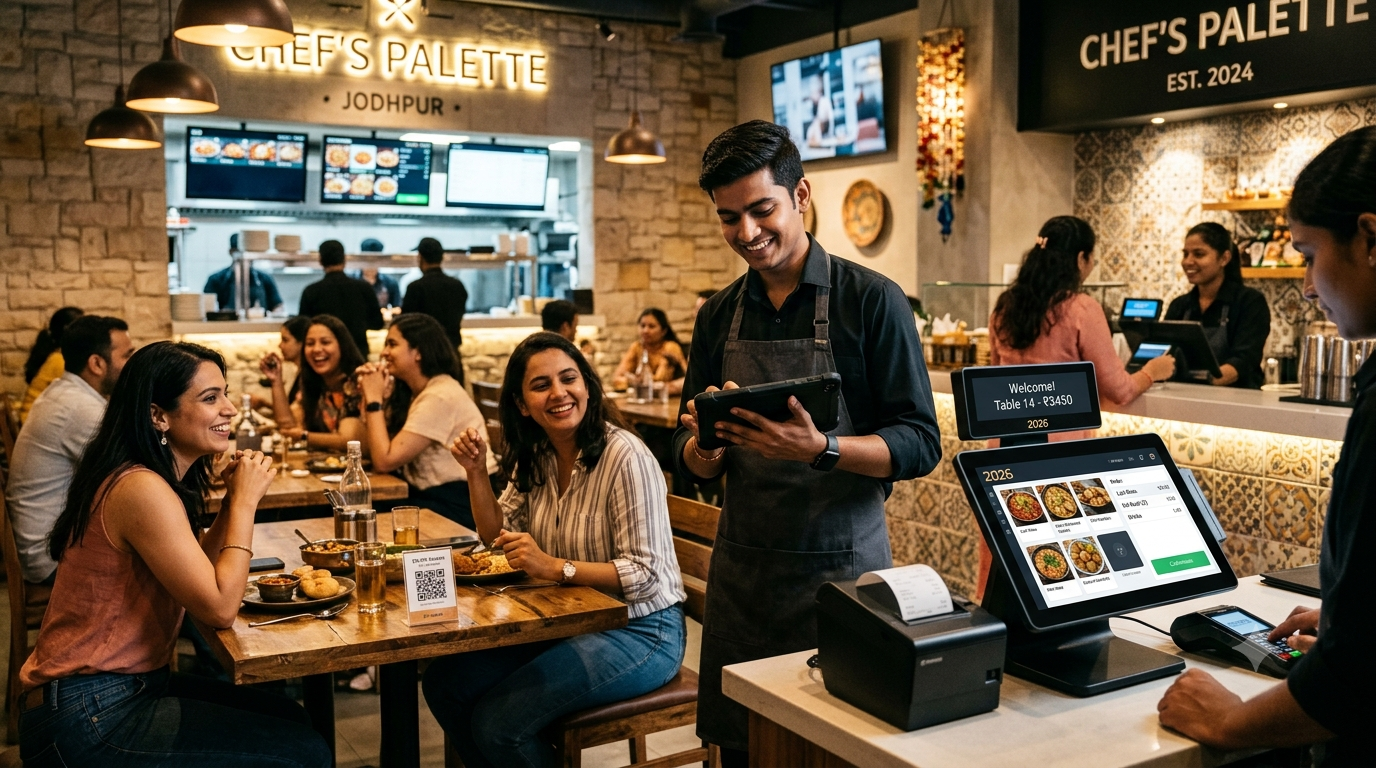
Running a restaurant in 2026 is about much more than serving great food.
Restaurant owners are managing rising operating costs, staff schedules, inventory, online orders, customer expectations, multiple payment methods, and increasingly complex day-to-day operations.
This is why a modern **restaurant POS system** has become more than a cash register.
Today’s POS technology can connect ordering, payments, inventory, kitchen operations, customer loyalty, reporting, and multiple locations into one connected ecosystem.
For restaurants looking to improve efficiency and profitability in 2026, choosing the right **restaurant point of sale system** can make a significant difference.
## What Is a Modern Restaurant POS System?
A traditional POS primarily handled transactions.
A modern restaurant POS can manage much more.
It can connect:
* Restaurant orders
* Table management
* Payments
* Kitchen operations
* Inventory
* Staff activity
* Online ordering
* Customer loyalty
* Sales analytics
* Multiple locations
The goal is to create one central system that gives restaurant owners greater visibility over their business.
For example:
**Customer Order → POS → Kitchen → Payment → Inventory → Reporting**
Instead of managing these processes separately, an integrated POS can connect them together.
## 1. Faster Order Taking
Speed matters in restaurants.
Long queues and slow order processing can negatively affect the customer experience, particularly during busy lunch and dinner periods.
Modern POS systems can allow staff to take orders quickly using POS terminals, tablets, handheld devices, or other ordering solutions.
MusePOS supports restaurant ordering through POS and waiter applications, while orders can be sent directly to kitchen printers or a Kitchen Display System.
This can help reduce communication problems between front-of-house and kitchen teams.
## 2. Kitchen Display Systems Improve Order Accuracy
The kitchen is one of the most important parts of restaurant operations.
When orders are written manually or communicated verbally, mistakes can happen.
A **Kitchen Display System (KDS)** can send orders digitally from the POS directly to kitchen staff.
Instead of asking:
**”Which table is this order for?”**
Kitchen staff can see the order information directly on the screen.
MusePOS supports KDS functionality along with kitchen printers, helping restaurants manage orders from the front of house to the kitchen.
## 3. Real-Time Inventory Management
Inventory management is directly connected to restaurant profitability.
Too much stock can lead to waste.
Too little stock can result in unavailable menu items and unhappy customers.
A restaurant POS with inventory management can help operators monitor:
* Stock levels
* Ingredient consumption
* Product movement
* Inventory counts
* Transfers
* Recipes
* Low-stock situations
MusePOS provides inventory tracking, stock transfers, inventory counts, inventory history, and recipe-related management features.
This gives restaurant owners better visibility into what is happening with their inventory.
## 4. Data Can Improve Restaurant Decisions
Restaurant owners generate valuable data every day.
Sales reports can reveal:
* Best-selling dishes
* Slow-moving items
* Peak sales periods
* Customer purchasing patterns
* Location performance
* Staff performance
* Revenue trends
Instead of relying entirely on intuition, restaurant operators can use these insights to make better decisions.
MusePOS provides sales reporting and analytics covering areas such as product performance, customer sales insights, and location-based reporting.
## 5. Online Ordering Is Becoming Part of the Restaurant Ecosystem
Customers increasingly expect restaurants to offer convenient digital ordering.
A restaurant may receive orders through:
* Its website
* Mobile applications
* Online ordering platforms
* In-store POS
* Self-ordering systems
The challenge is keeping these channels organized.
A connected restaurant technology ecosystem can help bring different ordering channels into a more manageable workflow.
MusePOS also offers online ordering solutions designed to help restaurants operate branded ordering websites and apps.
## 6. Contactless and Flexible Payments
Customers expect convenient payment options.
Depending on the restaurant and market, this can include:
* Credit cards
* Debit cards
* Contactless payments
* Mobile payments
* Digital wallets
* Other payment methods
Integrated payment processing can reduce manual steps for restaurant employees and help create a smoother checkout experience.
MusePOS supports multiple payment options and integrated payment processing.
## 7. Customer Loyalty Can Drive Repeat Business
Getting a customer through the door is only the beginning.
The bigger opportunity is encouraging that customer to return.
A modern restaurant POS can connect customer information with loyalty programs, purchase history, rewards, and promotions.
For example:
**Customer visits → Purchase recorded → Loyalty points earned → Reward offered → Customer returns**
MusePOS includes customer profiles, loyalty cards, purchase history, points-based rewards, and customer notes.
These features can help restaurants create more personalized customer experiences.
## 8. Multi-Location Restaurants Need Centralized Management
Managing one restaurant is challenging.
Managing five, ten, or fifty locations can be significantly more complicated.
Multi-location restaurant businesses need centralized visibility into:
* Sales
* Inventory
* Products
* Staff
* Locations
* Reports
* Pricing
* Operations
A centralized POS platform can make it easier for management teams to monitor multiple locations.
MusePOS supports multi-location management and centralized reporting, with its Premium plan designed for multi-location restaurants and food chains.
## 9. Offline POS Capability Matters
Internet connectivity isn’t always perfect.
A restaurant shouldn’t necessarily have to stop taking orders simply because the internet connection goes down.
Offline POS functionality can allow businesses to continue operating and synchronize data once connectivity is restored.
MusePOS supports offline sales and automatic synchronization when the internet connection returns.
For busy restaurants, this can provide an important layer of operational resilience.
## 10. AI Is Changing Restaurant Technology
One of the biggest technology developments in the restaurant industry is the growing use of AI.
Restaurant technology is increasingly using AI and analytics to help operators understand data, predict outcomes, and make faster decisions.
Potential applications include:
* Sales forecasting
* Inventory optimization
* Demand prediction
* Staff scheduling
* Customer personalization
* Menu analysis
* Business reporting
The important point is that AI should support restaurant operators rather than replace the human side of hospitality.
Technology can handle repetitive processes while restaurant teams focus on creating great customer experiences.
## What Should Restaurants Look for in a POS in 2026?
Restaurant owners comparing POS platforms should look beyond the number of features.
A strong restaurant POS should provide:
### Easy-to-Use Interface
Employees should be able to learn the system quickly.
### Reliable Performance
The system should work consistently during busy periods.
### Offline Capability
Restaurants should have a backup when internet connectivity becomes unavailable.
### Inventory Management
Operators should have clear visibility into stock and product movement.
### Kitchen Integration
Orders should reach the kitchen accurately and quickly.
### Payment Flexibility
Customers should have convenient payment options.
### Reporting and Analytics
Managers should be able to understand business performance.
### Integrations
The POS should be capable of connecting with other business applications and services.
### Scalability
The system should be suitable for a single restaurant as well as growing restaurant groups.
## Why an All-in-One Restaurant POS Can Be Valuable
Many restaurant businesses use separate systems for:
**POS + Payments + Inventory + Online Ordering + Loyalty + Reporting + Kitchen**
The problem is that disconnected systems can create data silos and additional management work.
An integrated POS platform can bring these functions together.
MusePOS provides POS, inventory management, customer loyalty, restaurant features, payment integrations, APIs, online ordering, and multi-location capabilities within its broader platform.
This can help restaurant operators spend less time switching between systems and more time running their business.
## The Future of Restaurant POS
The restaurant POS is evolving from a transaction system into a **restaurant operations platform**.
The future is likely to involve greater integration between:
**POS + AI + Payments + Inventory + Kitchen + Online Ordering + Customer Data + Analytics**
The restaurant of the future won’t simply use technology to process payments.
It will use technology to understand its operations.
It will know:
* What customers are ordering
* Which products are performing best
* When demand is increasing
* Which ingredients need attention
* How each location is performing
* Where operational bottlenecks exist
And increasingly, software will help restaurant managers act on those insights.
## Conclusion
A restaurant POS system is no longer just a tool for taking payments.
In 2026, it can become the **central technology platform connecting restaurant operations**.
From faster ordering and kitchen communication to inventory management, customer loyalty, online ordering, payments, analytics, and multi-location management, the right POS can help restaurants operate more efficiently.
For restaurant owners, the question isn’t simply:
**”How much does a POS system cost?”**
The better question is:
**”How much more efficiently could my restaurant operate with the right POS system?”**
With the right technology in place, restaurants can reduce operational friction, improve customer experiences, make better decisions, and create a stronger foundation for growth.
Leave a Reply