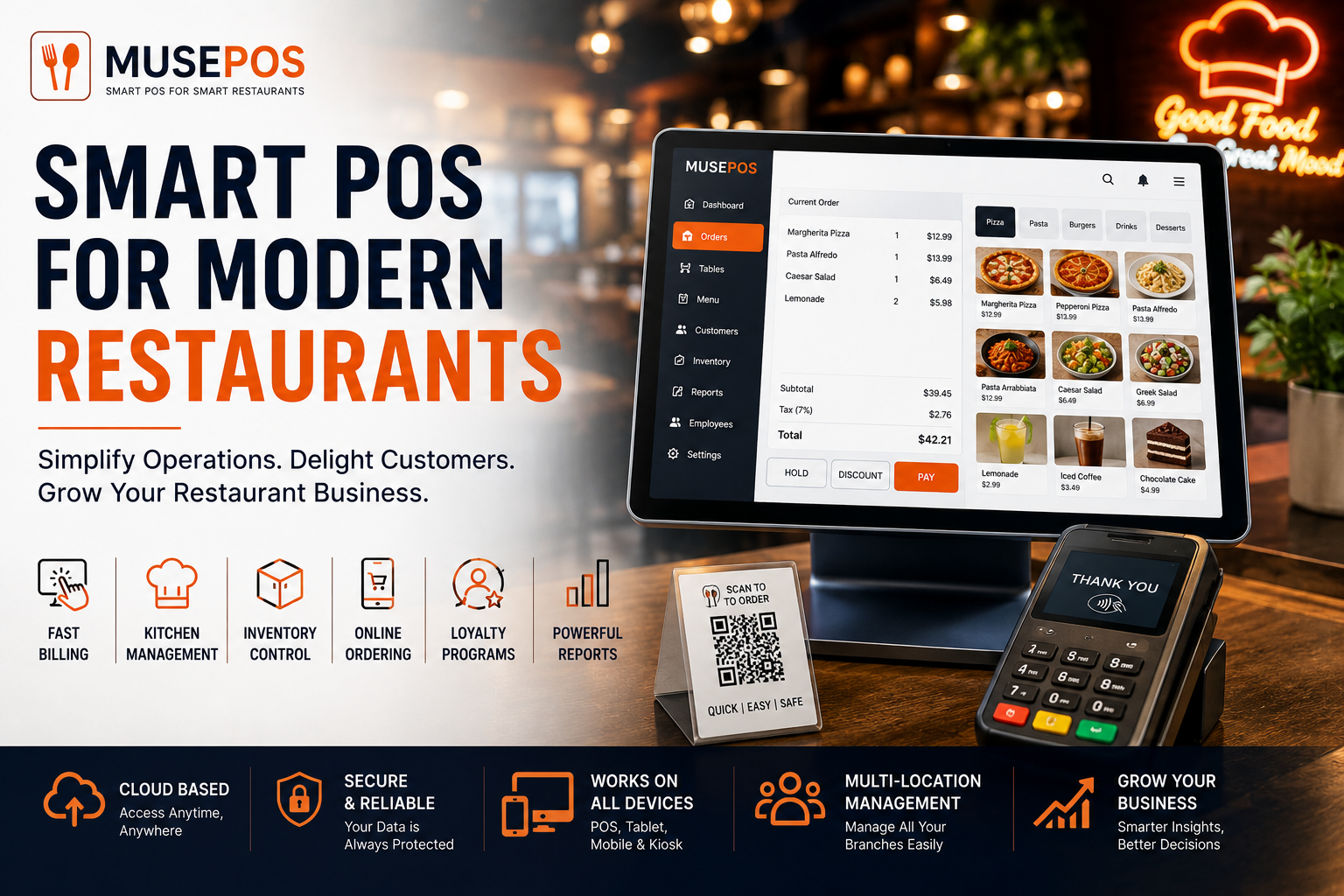
The restaurant industry has changed dramatically over the past few years.
Customers now expect fast ordering, contactless payments, online delivery, loyalty rewards, and personalized dining experiences. At the same time, restaurant owners must manage rising operational costs, staff shortages, inventory control, and multiple sales channels.
Trying to handle all of these tasks with traditional billing software is no longer practical.
That’s why modern Restaurant POS Software has become the central hub for restaurant operations. It goes far beyond processing payments—it helps restaurants streamline workflows, reduce waste, improve customer service, and make smarter business decisions.
Whether you run a café, food truck, fine-dining restaurant, quick-service chain, or multi-location franchise, a powerful POS system can transform the way you operate.
What Is Restaurant POS Software?
Restaurant POS (Point of Sale) software is a complete management platform designed specifically for food service businesses.
It combines billing, payment processing, kitchen operations, inventory management, employee scheduling, customer management, and business reporting into one centralized system.
Instead of using multiple disconnected tools, restaurants can manage everything from a single dashboard.
Why Restaurants Need Modern POS Software
Today’s restaurants serve customers through multiple channels:
Dine-in
Takeaway
Online ordering
Delivery platforms
QR code ordering
Mobile ordering
Managing these channels manually often leads to:
Order mistakes
Slow service
Inventory issues
Billing errors
Poor customer experiences
A modern POS system automates these processes, allowing staff to focus on serving customers.
Essential Features of Restaurant POS Software
1. Fast & Accurate Billing
A restaurant POS should enable staff to process orders quickly and accurately.
Key capabilities include:
Touchscreen ordering
Split bills
Multiple payment options
Digital receipts
Tax calculations
Discount management
2. Kitchen Display System (KDS)
Instead of relying on printed tickets, orders are sent directly to kitchen displays.
Benefits include:
Faster food preparation
Reduced communication errors
Improved order accuracy
Better kitchen workflow
3. Inventory Management
Food inventory changes constantly.
A smart POS automatically tracks:
Ingredient usage
Stock levels
Supplier orders
Low-stock alerts
Waste reporting
Cost analysis
This helps reduce food waste and control expenses.
4. Online Ordering Integration
Modern POS software should integrate with:
Restaurant websites
Mobile apps
Delivery platforms
QR menu systems
Self-order kiosks
Orders from every channel appear in one place, simplifying operations.
5. Customer Loyalty Programs
Repeat customers are essential for long-term success.
Restaurant POS systems can support:
Loyalty points
Coupons
Birthday rewards
Membership discounts
Personalized promotions
Customer purchase history
6. Employee Management
Managing restaurant staff becomes easier with features like:
Employee scheduling
Time tracking
Role-based permissions
Performance reporting
Sales tracking
Cloud-Based Restaurant POS
Cloud technology gives restaurant owners the flexibility to manage their business from anywhere.
Advantages include:
Remote access
Automatic software updates
Secure cloud backups
Multi-location management
Real-time reporting
Improved scalability
Whether you’re in the restaurant or traveling, your business data is always accessible.
AI Is Changing Restaurant Operations
Artificial Intelligence is becoming an important part of modern restaurant management.
AI-powered POS systems can help with:
Sales forecasting
Demand prediction
Smart menu recommendations
Inventory optimization
Customer behavior analysis
Dynamic promotions
These insights help restaurants make informed decisions and improve profitability.
Contactless Dining Is Here to Stay
Customers increasingly expect convenient and hygienic dining experiences.
Modern POS systems support:
QR code menus
Contactless payments
Mobile wallets
Digital receipts
Self-service ordering
These features improve speed while reducing wait times.
Multi-Location Restaurant Management
Restaurant chains require centralized control.
A modern POS allows owners to manage:
Multiple branches
Unified inventory
Staff permissions
Sales reports
Menu updates
Performance dashboards
All locations can be monitored from one system.
Data Security Matters
Restaurants process sensitive customer and payment information every day.
A secure POS system should include:
Encrypted transactions
Role-based access control
Secure cloud storage
Regular backups
Audit logs
Payment security best practices
Strong security helps protect both customers and business operations.
Benefits of Restaurant POS Software
Restaurants using modern POS solutions often experience:
Faster order processing
Reduced billing errors
Better inventory control
Improved customer satisfaction
Higher staff productivity
Smarter business insights
Easier multi-location management
Increased revenue opportunities
Why Choose a Custom Restaurant POS?
Every restaurant has unique workflows.
A custom POS solution can be tailored to support:
Custom menu management
Specialized pricing rules
Kitchen workflows
Loyalty programs
Third-party integrations
Branded mobile apps
Franchise management
Advanced reporting
Instead of adapting your business to generic software, custom development allows the software to adapt to your business.
Restaurant Technology Trends in 2026
Restaurants are increasingly investing in:
AI-powered analytics
QR ordering
Contactless payments
Self-service kiosks
Voice-assisted ordering
Cloud-native POS systems
Real-time inventory management
Customer personalization
Mobile-first restaurant management
Omnichannel ordering
Why MusePOS?
A modern restaurant needs more than just billing software.
MusePOS is designed to help restaurants simplify operations, improve customer experiences, and grow with confidence.
With features such as:
Fast billing
Kitchen management
Inventory tracking
Online ordering integration
Customer loyalty programs
Cloud accessibility
Business analytics
Secure payment support
MusePOS enables restaurants to operate more efficiently while staying prepared for the future of digital dining.
Conclusion
Restaurant technology continues to evolve, and businesses that embrace modern POS solutions are better equipped to meet changing customer expectations and operational challenges.
Whether you’re opening your first café or managing a growing restaurant chain, investing in a feature-rich restaurant POS system can improve efficiency, enhance customer satisfaction, and support long-term growth.
The future of restaurant management is smart, connected, and data-driven—and the right POS system is at the center of it.
Frequently Asked Questions
What is Restaurant POS Software?
Restaurant POS software is a platform that helps restaurants manage billing, orders, inventory, payments, employees, customer loyalty, and business reporting from a single system.
Can Restaurant POS Software manage online orders?
Yes. Modern POS systems can integrate with restaurant websites, mobile apps, delivery services, QR ordering, and other online ordering channels.
Is cloud-based POS better for restaurants?
Cloud-based POS solutions offer remote access, automatic updates, secure backups, real-time reporting, and easier multi-location management.
Can a POS system help reduce food waste?
Yes. Inventory tracking, ingredient monitoring, and demand forecasting help restaurants optimize stock levels and minimize waste.
Why should restaurants choose MusePOS?
MusePOS provides a comprehensive restaurant management solution with billing, inventory, kitchen operations, online ordering, customer loyalty, analytics, and cloud-based management—helping restaurants operate more efficiently and deliver better customer experiences.
Leave a Reply