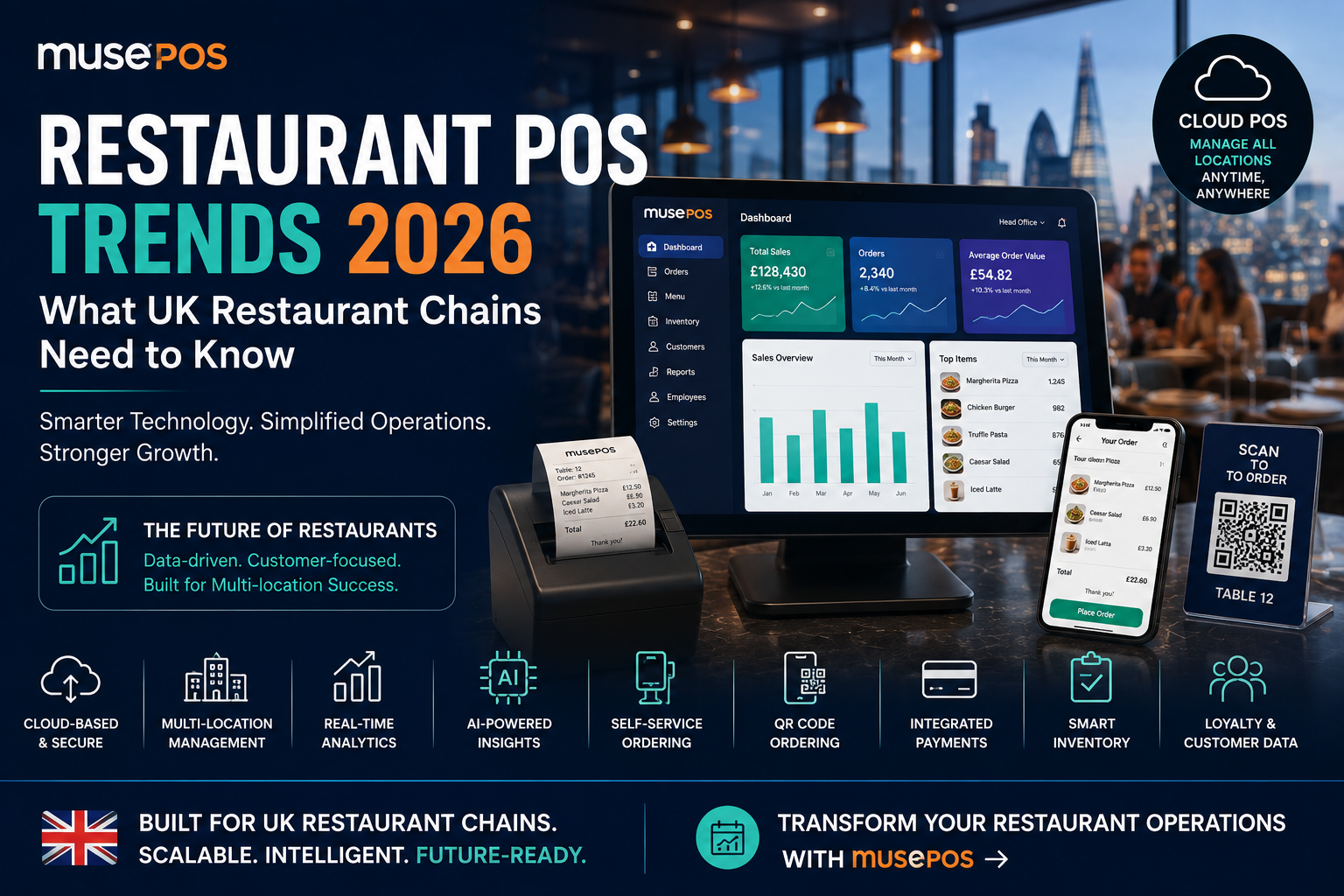
The restaurant industry is changing rapidly.
For independent restaurants, choosing a point-of-sale system is important. But for **restaurant chains**, the decision is even more critical.
A multi-location restaurant business needs more than a system that simply processes orders and prints receipts. Modern restaurant chains need technology that can connect locations, centralize operations, improve reporting, support multiple payment methods, automate repetitive tasks, and provide a consistent customer experience.
In 2026, restaurant POS technology is becoming increasingly intelligent and connected.
From cloud-based management and AI-powered insights to self-service ordering and real-time multi-site reporting, the modern POS system is becoming the **central technology platform for restaurant operations**.
So, what should UK restaurant chains look for when upgrading their POS infrastructure?
Let’s explore the most important restaurant POS trends for 2026.
# 1. Cloud-Based POS Is Becoming the Standard
Traditional POS systems often depend heavily on local hardware and servers.
Cloud-based POS systems provide a different approach.
Restaurant data can be securely managed through cloud infrastructure, allowing authorized teams to access important information across multiple locations.
For restaurant chains, this can simplify:
* Menu management
* Sales reporting
* Staff management
* Inventory monitoring
* Pricing updates
* Location management
* Performance analysis
Instead of managing every restaurant separately, headquarters can have a centralized view of the business.
### Why This Matters for Restaurant Chains
Imagine a restaurant group with 30 locations.
With a centralized POS platform, management can potentially update a menu item, pricing rule, promotion, or configuration across multiple locations without manually repeating the same task at every site.
That can save considerable operational time.
# 2. Multi-Location Restaurant Management
One of the biggest POS requirements for restaurant chains is **multi-site management**.
A chain may operate restaurants across different cities, each with different:
* Sales volumes
* Staff
* Menus
* Operating hours
* Inventory
* Customer demographics
However, management still needs centralized visibility.
Modern restaurant POS platforms are increasingly designed to provide:
**Head Office → Multiple Locations → Centralized Data → Real-Time Reporting**
Restaurant managers can focus on their individual locations while head-office teams maintain a broader view of the business.
# 3. Real-Time Restaurant Analytics
Restaurant chains generate enormous amounts of data every day.
Sales data can reveal:
* Best-selling products
* Slow-moving items
* Peak ordering times
* Average transaction values
* Location performance
* Staff performance
* Popular payment methods
* Customer ordering patterns
In 2026, restaurant businesses increasingly expect POS systems to turn this data into useful insights.
Instead of simply asking:
**“How much did we sell?”**
Restaurant operators can ask:
**“Which locations are performing best, which products are driving revenue, and where are operational improvements needed?”**
Real-time dashboards can make these insights easier to access.
# 4. AI-Powered Restaurant POS
Artificial intelligence is becoming an important part of modern restaurant technology.
AI can potentially help restaurant chains analyze large amounts of operational data and identify patterns that may not be immediately obvious.
Potential applications include:
* Sales forecasting
* Demand prediction
* Inventory recommendations
* Product recommendations
* Customer segmentation
* Staff scheduling assistance
* Automated reporting
* Anomaly detection
For example, an AI-powered POS system could analyze historical sales and identify patterns around busy periods.
Restaurant managers could then use those insights when planning staffing and inventory.
The goal isn’t to replace restaurant managers.
The goal is to **give managers better information for making decisions**.
# 5. Self-Service Ordering
Customers increasingly expect convenient ordering experiences.
Restaurant chains can offer self-service options through:
* Self-ordering kiosks
* QR code menus
* Table ordering
* Mobile ordering
* Online ordering
* Digital menu boards
Self-service ordering can reduce pressure on front-of-house teams while giving customers more control over their orders.
For high-volume restaurants, this can be particularly valuable during peak periods.
# 6. QR Code Ordering
QR code ordering has become an important restaurant technology trend.
Customers can scan a QR code at the table and access a digital menu from their smartphone.
Depending on the POS ecosystem, the customer may be able to:
**Scan → Browse Menu → Customize Order → Pay → Receive Confirmation**
For restaurant chains, QR ordering can also create a more consistent digital ordering experience across locations.
# 7. Integrated Online Ordering
Restaurant customers increasingly use multiple channels.
They may order through:
* Restaurant websites
* Mobile applications
* Online ordering platforms
* In-store POS
* QR codes
* Self-service kiosks
A modern POS system should ideally help restaurant businesses manage these channels without creating disconnected workflows.
A connected ecosystem can look like:
**Online Order → POS → Kitchen → Inventory → Payment → Reporting**
This reduces the need for staff to manually transfer information between systems.
# 8. Kitchen Display System Integration
The POS is no longer limited to the front counter.
Modern restaurant technology can connect the POS directly with kitchen operations.
A typical workflow can be:
**Customer Order → POS → Kitchen Display System → Food Preparation → Order Completion**
Kitchen Display Systems can help restaurants organize incoming orders and provide kitchen staff with clearer information.
For restaurant chains, standardized kitchen workflows can also help maintain consistency across locations.
# 9. Better Inventory Management
Food waste and inventory inefficiency can significantly affect restaurant profitability.
POS systems can help restaurant businesses connect sales data with inventory processes.
For example:
**Order Sold → Ingredient Usage → Inventory Updated → Stock Level Monitored**
This creates better visibility into what is being consumed.
Restaurant chains can use inventory information to identify:
* High-usage ingredients
* Slow-moving stock
* Potential shortages
* Waste patterns
* Location-level differences
Better inventory visibility can support more informed purchasing decisions.
# 10. Integrated Payments
Payments are becoming increasingly diverse.
Restaurant customers may use:
* Contactless cards
* Chip-and-PIN cards
* Mobile wallets
* Digital payment methods
* Online payments
For restaurant chains, payment integration is particularly important because payment data needs to connect with sales reporting and reconciliation.
A connected system can reduce manual work and make transaction information easier to track.
# 11. Loyalty and Customer Data Integration
Restaurant chains need to build long-term relationships with customers.
A POS system can become an important source of customer information when used appropriately and with proper privacy controls.
Businesses can potentially connect POS data with loyalty programs to understand:
* Purchase frequency
* Customer preferences
* Popular products
* Visit patterns
* Promotional engagement
This can support more personalized marketing campaigns.
For example, a restaurant chain could create targeted offers based on customer purchase behavior rather than sending the same promotion to every customer.
# 12. Omnichannel Restaurant Experiences
Customers don’t think in terms of separate restaurant systems.
They simply want a convenient experience.
They may:
**Discover Restaurant → Order Online → Collect Food → Earn Loyalty Points → Return to Restaurant**
Modern restaurant technology needs to support this connected journey.
An omnichannel POS ecosystem can help connect:
* In-store orders
* Online orders
* Mobile orders
* Delivery
* Loyalty
* Payments
* Customer data
This creates a more consistent experience across channels.
# 13. Centralized Menu Management
Managing menus across multiple restaurants can become complicated.
A chain may need to update:
* Prices
* Ingredients
* Promotions
* Product availability
* Meal combinations
* Seasonal products
A centralized POS platform can make these updates easier to manage.
Head-office teams can establish standardized menus while allowing individual locations to have appropriate local configurations.
This is especially useful for growing restaurant groups.
# 14. Automated Reporting
Restaurant managers shouldn’t have to spend hours creating spreadsheets to understand business performance.
Modern POS systems can automate reporting around:
* Daily sales
* Weekly sales
* Monthly revenue
* Product performance
* Location performance
* Staff activity
* Payment transactions
* Discounts
* Refunds
Automated reports allow managers to spend less time collecting information and more time acting on it.
# 15. Better Staff Management
Restaurant operations depend heavily on employees.
POS technology can support staff-related processes such as:
* User accounts
* Role-based permissions
* Shift information
* Sales performance
* Order activity
* Manager approvals
For restaurant chains, centralized staff management can provide better visibility while allowing individual restaurants to maintain local operational control.
# 16. Stronger POS Security
Restaurant POS systems handle important business information and payment-related data.
Security should therefore be a major consideration when selecting a POS platform.
Restaurant chains should evaluate:
* User permissions
* Secure authentication
* Payment security
* Data encryption
* Audit logs
* Access controls
* System monitoring
* Backup processes
Different systems and payment environments have different compliance requirements, so businesses should evaluate security according to their specific setup.
# 17. POS Integration With Existing Business Systems
A restaurant chain rarely operates using only a POS.
It may already have:
* Accounting software
* Payroll systems
* CRM
* Inventory platforms
* Loyalty software
* Online ordering
* Delivery systems
* Payment platforms
* Business intelligence tools
The POS should fit into this technology ecosystem.
APIs and integrations can help connect these systems.
For example:
**POS → Accounting System**
**POS → Inventory Platform**
**POS → Loyalty Platform**
**POS → Online Ordering**
**POS → Analytics Dashboard**
This creates a more connected restaurant operation.
# 18. Mobile POS
Mobile POS systems allow staff to take orders using mobile devices rather than relying entirely on fixed terminals.
This can be useful for:
* Table service
* Events
* Food halls
* Outdoor dining
* Pop-up locations
* High-volume restaurants
Staff can potentially take orders directly at the table and send them to the kitchen without returning to a fixed terminal.
# 19. Personalized Restaurant Experiences
Restaurant technology is increasingly moving toward personalization.
POS and customer data can help businesses understand customer preferences and create more relevant experiences.
For example:
A returning customer may receive a personalized recommendation based on previous purchases.
Restaurant chains can also use customer insights to develop targeted promotions and loyalty campaigns.
The key is to use customer data responsibly and transparently.
# 20. POS as the Central Restaurant Technology Hub
Perhaps the biggest POS trend of 2026 is that the POS is becoming much more than a cash register.
It can act as the central hub connecting:
**Orders + Payments + Kitchen + Inventory + Customers + Loyalty + Analytics + Management**
This is particularly important for restaurant chains.
Instead of having disconnected systems, businesses can build an integrated technology ecosystem.
# How to Choose a POS for a Restaurant Chain
Restaurant chains should evaluate more than the appearance of the POS interface.
Important questions include:
### Can it manage multiple locations?
A chain needs centralized control with location-level management.
### Can it integrate with existing systems?
Check APIs and available integrations.
### Does it support online ordering?
Digital ordering is increasingly important for restaurant businesses.
### Does it provide real-time reporting?
Management needs visibility across locations.
### Can menus be managed centrally?
Centralized menu management can save significant time.
### Does it support different payment methods?
Payment flexibility is important for modern restaurants.
### Is the system scalable?
A POS should support the business as it grows from five locations to 50 or more.
### Does it provide security controls?
Restaurant chains need appropriate permissions, authentication, and data protection.
### Is training simple?
Restaurant employees need to learn the system quickly.
# Why Restaurant Chains Are Moving Beyond Traditional POS
Traditional POS systems were primarily designed to process transactions.
Modern restaurant chains need much more.
They need technology that can:
**Sell → Analyze → Automate → Integrate → Personalize → Scale**
This is why the modern POS is increasingly becoming a strategic business platform.
The right system can help restaurant chains improve operational visibility while creating a better experience for customers and employees.
# How MusePOS Can Help Restaurant Chains
For growing restaurant businesses, choosing the right POS technology is an important investment.
**MusePOS** is designed around the needs of modern restaurant operations, helping businesses manage ordering and POS processes while creating a foundation for connected restaurant technology.
For restaurant chains, the focus should be on creating a system that can support:
* Multiple locations
* Centralized management
* Restaurant operations
* Digital ordering
* Reporting
* Payments
* Inventory workflows
* Customer experiences
* Business growth
As restaurant businesses expand, their technology should grow with them.
# The Future of Restaurant POS
The restaurant POS of the future won’t simply process payments.
It will increasingly connect the entire restaurant ecosystem.
Imagine:
**Customer Orders → AI Assists → POS Processes → Kitchen Receives → Inventory Updates → Payment Completes → Loyalty Records Purchase → Analytics Measures Performance**
That’s the direction restaurant technology is moving toward.
For restaurant chains, this means choosing a POS system should be treated as a **strategic technology decision**, not simply a hardware purchase.
# Conclusion
Restaurant POS technology is evolving rapidly in 2026.
Cloud systems, AI, automation, integrated payments, self-service ordering, QR ordering, real-time analytics, centralized menu management, loyalty integration, and multi-location management are changing how restaurant chains operate.
For growing restaurant businesses, the right POS can become the foundation for a connected digital ecosystem.
The key is to choose a platform that doesn’t just handle today’s transactions but can support tomorrow’s growth.
**For restaurant chains planning their next stage of growth, now is the time to rethink what a POS system can actually do.**
### Ready to Modernize Your Restaurant POS?
If you’re managing multiple restaurant locations and looking for a scalable POS platform, **MusePOS can help you build a more connected and efficient restaurant operation.**
**Explore how MusePOS can support your restaurant chain and prepare your business for the future of restaurant technology.**
Leave a Reply