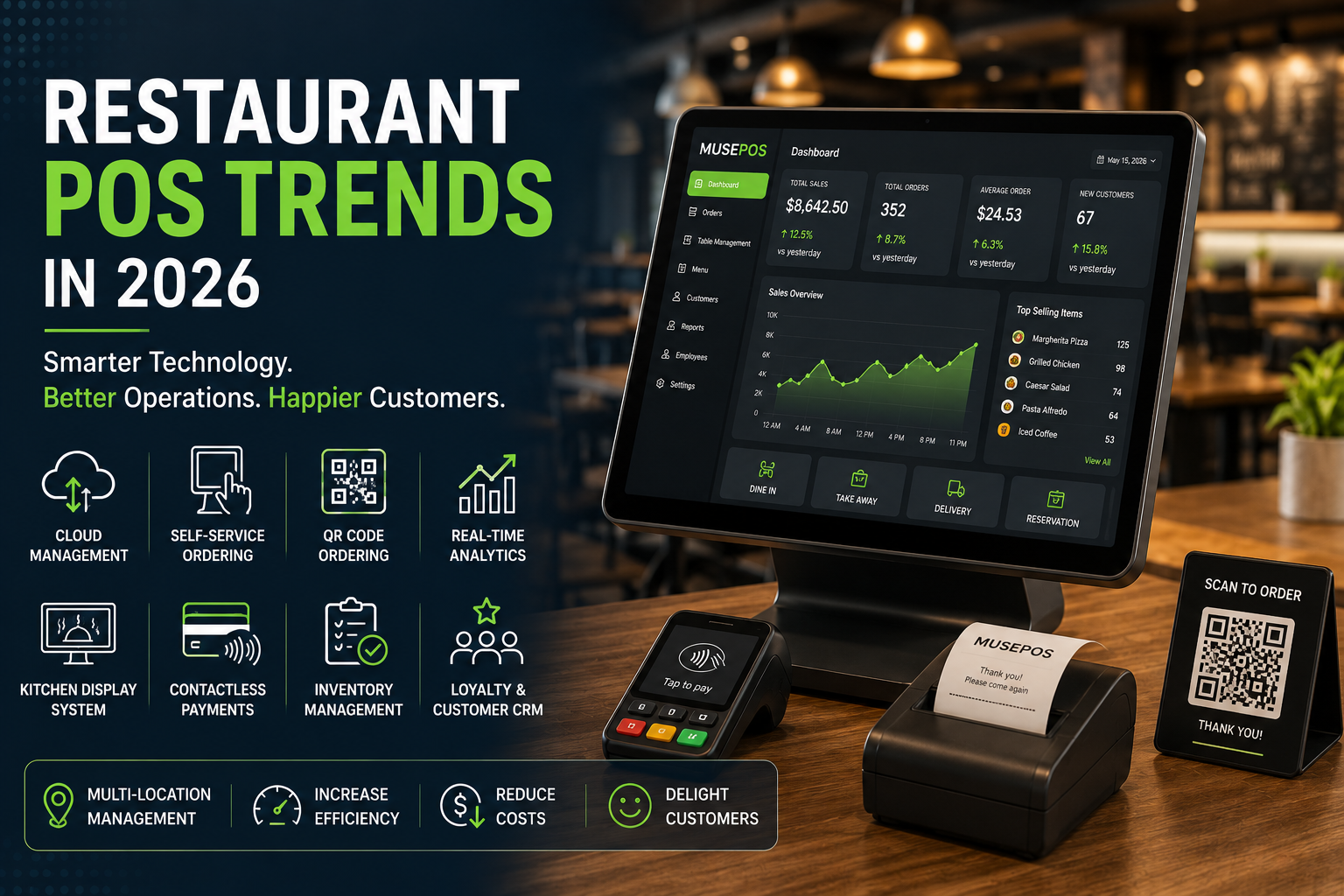
The restaurant industry is becoming increasingly digital. In 2026, restaurants are no longer using POS systems only to process bills and accept payments. Modern restaurant POS platforms are becoming central business systems that connect orders, kitchens, inventory, customers, employees, payments, and analytics.
For restaurant chains and growing food businesses, choosing the right POS technology can improve operational efficiency, reduce errors, and create a more consistent customer experience across locations.
## What Is a Modern Restaurant POS System?
A modern restaurant POS system is a digital platform that manages the complete order-to-payment process while connecting different areas of restaurant operations.
Depending on the business, a restaurant POS can manage:
* Dine-in orders
* Takeaway orders
* Online orders
* Table management
* Kitchen orders
* Payments
* Inventory
* Menu management
* Customer information
* Employee operations
* Sales reporting
* Multi-location management
The latest POS systems are increasingly designed as connected platforms rather than standalone billing machines.
## Top Restaurant POS Trends in 2026
### 1. Cloud-Based Restaurant POS
Cloud technology continues to transform restaurant operations.
With a cloud-based POS, restaurant owners and managers can access business information from different locations while maintaining centralized control.
Cloud POS systems can provide:
* Real-time sales information
* Centralized menu management
* Remote reporting
* Automatic updates
* Multi-location visibility
* Centralized inventory information
For restaurant chains, cloud-based systems make it easier to manage multiple outlets from a single platform.
## 2. AI-Powered Restaurant Analytics
Artificial intelligence is becoming increasingly useful in restaurant technology.
AI-powered POS platforms can analyze historical and real-time data to identify patterns in:
* Sales
* Customer preferences
* Product demand
* Peak ordering times
* Inventory usage
* Restaurant performance
Restaurants can use these insights to make better decisions about staffing, menus, promotions, and inventory.
For example, historical sales data can help restaurants predict which menu items are likely to be in high demand during specific periods.
## 3. Self-Service Ordering
Self-service ordering is becoming more common across restaurants.
Customers can place orders through:
* Self-service kiosks
* QR codes
* Tablets
* Mobile applications
* Digital menus
This can reduce pressure on front-of-house staff while giving customers greater control over the ordering process.
For quick-service restaurants, self-ordering can also help increase order accuracy and speed.
## 4. QR Code Ordering
QR-based ordering has become an important part of modern restaurant technology.
Customers can scan a QR code at their table and view the digital menu directly on their smartphone.
Depending on the POS setup, customers may also be able to:
* Customize orders
* Add special instructions
* Place orders
* Request additional items
* Pay digitally
Orders can then be sent directly to the restaurant’s POS and kitchen systems.
## 5. Kitchen Display Systems
Kitchen Display Systems (KDS) are increasingly replacing traditional paper tickets.
A KDS can display orders digitally and organize them according to preparation status.
Benefits can include:
* Better order visibility
* Reduced ticket errors
* Faster communication
* Improved kitchen workflow
* Easier order prioritization
A POS integrated with a KDS can connect front-of-house ordering directly with kitchen operations.
## 6. Omnichannel Restaurant Ordering
Customers now expect restaurants to support multiple ordering channels.
A modern restaurant POS can bring together orders from:
* In-store customers
* Restaurant websites
* Mobile applications
* Online ordering systems
* Delivery channels
* QR ordering
* Kiosks
Centralizing these orders can help restaurant teams manage demand more efficiently.
## 7. Contactless and Digital Payments
Payment preferences continue to evolve.
Modern restaurant POS systems increasingly support:
* Contactless cards
* Digital wallets
* Mobile payments
* QR payments
* Integrated payment terminals
Fast payment experiences can reduce queues and improve the overall customer journey.
## 8. Real-Time Inventory Management
Inventory management is critical for restaurant profitability.
Modern POS systems can automatically connect sales with inventory information.
Restaurants can monitor:
* Ingredient usage
* Stock levels
* Product availability
* Waste
* Purchase requirements
* Menu item performance
Real-time inventory information can help restaurants reduce stock shortages and unnecessary waste.
## 9. Multi-Location Restaurant Management
Restaurant chains require centralized technology to maintain consistency across locations.
A multi-location POS can allow businesses to manage:
* Menus
* Pricing
* Promotions
* Employees
* Inventory
* Sales reports
* Taxes
* Permissions
from a centralized platform.
Managers can also compare performance between individual locations and identify opportunities for improvement.
## 10. Customer Loyalty and Personalization
Customer retention is becoming increasingly important for restaurants.
POS systems can connect transaction data with loyalty programs to create more personalized experiences.
Restaurants can use customer information to support:
* Loyalty points
* Digital rewards
* Personalized offers
* Purchase history
* Birthday promotions
* Customer segmentation
When integrated with CRM and marketing platforms, POS data can become a valuable customer engagement tool.
## 11. Restaurant POS Mobile Apps
Mobile POS technology provides greater flexibility for restaurant staff.
Employees can use tablets or handheld devices to take orders directly at tables or throughout the restaurant.
Mobile POS can help:
* Reduce waiting times
* Improve order accuracy
* Speed up table service
* Reduce queues
* Improve staff productivity
This is especially useful for restaurants with high customer volumes.
## 12. Advanced Restaurant Reporting
Restaurant owners need accurate information to make effective business decisions.
Modern POS reporting can provide insights into:
* Daily revenue
* Average order value
* Best-selling dishes
* Slow-moving products
* Peak hours
* Employee performance
* Location performance
* Payment methods
Advanced dashboards can turn raw transaction data into actionable business intelligence.
## How Restaurant POS Technology Benefits Restaurant Chains
For restaurant chains, a modern POS platform can provide benefits across multiple locations.
### Centralized Management
Head-office teams can manage important information from a central system.
### Consistent Operations
Menus, pricing, promotions, and workflows can be standardized across locations.
### Better Decision-Making
Centralized data allows management to compare restaurants and identify trends.
### Improved Efficiency
Automated processes can reduce manual work and operational errors.
### Easier Expansion
A scalable POS architecture can make it easier to add new restaurant locations.
## What Should Restaurants Look for in a POS System?
Before selecting a restaurant POS platform, businesses should evaluate their current and future requirements.
Important considerations include:
* Ease of use
* Cloud capabilities
* Payment integrations
* Inventory management
* Kitchen integration
* Online ordering
* Multi-location support
* Customer loyalty
* Reporting and analytics
* Security
* Third-party integrations
* Scalability
The right POS should support the restaurant’s business model rather than forcing the restaurant to completely change its workflows.
## The Future of Restaurant POS
Restaurant POS systems are moving toward becoming intelligent restaurant management platforms.
The future will increasingly combine:
* AI
* Automation
* Cloud computing
* Mobile ordering
* Digital payments
* IoT devices
* Customer analytics
* Real-time inventory management
AI-powered recommendations may help restaurant managers understand demand, optimize inventory, and identify operational opportunities.
At the same time, automation will reduce repetitive tasks and allow restaurant employees to focus more on customer service.
## How to Choose the Right POS for a Restaurant Chain
Restaurant chains should consider more than the number of features when selecting a POS platform.
The system should be able to scale with the organization and support centralized management without compromising the flexibility required by individual locations.
A strong evaluation process should consider:
1. Current operational requirements
2. Number of restaurant locations
3. Expected business growth
4. Integration requirements
5. Staff training requirements
6. Reporting needs
7. Payment requirements
8. Security and reliability
9. Customer ordering channels
10. Long-term scalability
## Conclusion
Restaurant POS technology is rapidly evolving in 2026. Cloud platforms, AI analytics, self-service ordering, QR ordering, kitchen display systems, digital payments, inventory automation, and multi-location management are changing how restaurants operate.
For restaurant chains, the POS system is becoming much more than a billing solution. It is becoming a central platform for managing operations, customers, employees, inventory, and business intelligence.
Restaurants that invest in flexible and scalable POS technology can improve operational efficiency while creating faster and more convenient experiences for customers.
**Suggested SEO Keywords:** restaurant POS trends 2026, restaurant POS software, restaurant POS system, cloud restaurant POS, restaurant management software, POS software for restaurants, multi-location restaurant POS, restaurant billing software, AI restaurant POS, restaurant technology trends 2026
Leave a Reply