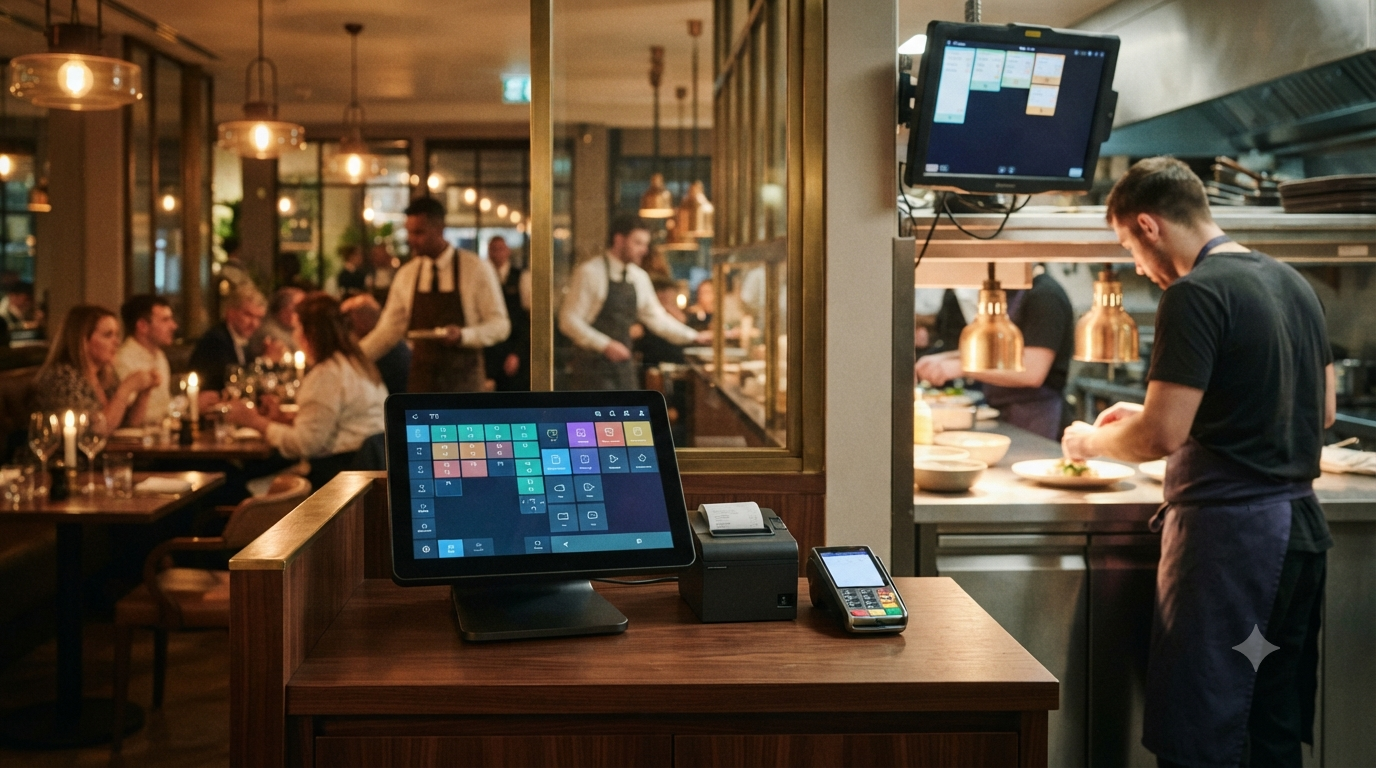
# Beyond the Till: How Modern Restaurant EPOS Systems Are Transforming UK Hospitality in 2026
Running a restaurant is about much more than serving great food. Restaurant owners must manage orders, payments, kitchen operations, inventory, staff, and customer experiences while keeping daily operations running smoothly.
As the UK hospitality industry becomes increasingly digital, traditional cash registers are no longer enough to meet the demands of modern food businesses.
Today’s restaurants need smarter technology that connects front-of-house activities with kitchen operations, inventory management, and business reporting.
This is where modern Electronic Point of Sale (EPOS) systems make a difference.
In 2026, restaurant EPOS software is evolving into a complete business management solution, helping cafés, restaurants, pubs, takeaways, and hotels improve operational efficiency and deliver better customer experiences.
## What Is a Modern Restaurant EPOS System?
An Electronic Point of Sale (EPOS) system combines software and hardware to manage restaurant transactions and daily operations.
Unlike traditional cash registers, modern EPOS solutions offer multiple features through a connected platform.
A restaurant EPOS system can help businesses manage:
– Order taking and billing.
– Table and reservation management.
– Kitchen Order Tickets (KOT).
– Kitchen Display Systems (KDS).
– Inventory and stock tracking.
– Contactless and card payments.
– Customer information and loyalty.
– Sales reports and business analytics.
– Online and takeaway orders.
By bringing these operations together, restaurant owners can reduce manual work and maintain better control over their businesses.
## Why UK Restaurants Are Moving Towards Smart EPOS Solutions in 2026
Customer expectations are changing. People want faster ordering, convenient payment options, accurate bills, and consistent service.
At the same time, restaurant owners are dealing with rising operational costs, staff shortages, and increasing competition.
Modern EPOS software helps address these challenges through automation and connected workflows.
### 1. Faster Order Management
During busy restaurant hours, manually writing orders and transferring them to the kitchen can create unnecessary delays.
A modern restaurant POS system allows staff to enter orders directly into the software.
Orders can then be routed to the appropriate kitchen station or display screen.
This helps restaurants:
– Reduce manual order entry.
– Minimize communication errors.
– Improve order accuracy.
– Manage busy service periods.
– Coordinate front-of-house and kitchen teams.
### 2. Smarter Kitchen Management
The kitchen is the heart of every restaurant, and poor order coordination can affect the entire customer experience.
Kitchen Display Systems replace traditional paper tickets with digital order screens.
Kitchen staff can view incoming orders, monitor preparation progress, and manage order priorities.
For restaurants with multiple preparation stations, orders can be routed to the relevant departments.
This creates a more organized kitchen workflow and helps staff manage high-volume service.
### 3. Better Inventory Control
Managing food inventory is one of the biggest operational challenges for restaurant owners.
Without accurate stock information, businesses may experience unnecessary food waste, unexpected shortages, and purchasing problems.
Restaurant inventory management software can help track stock movements and provide better visibility into ingredient availability.
Important capabilities include:
– Real-time stock updates.
– Ingredient-level inventory tracking.
– Low-stock notifications.
– Purchase management.
– Supplier information.
– Stock usage reports.
When integrated with sales data, inventory management can also help restaurant owners understand which products are selling and which ingredients need replenishment.
### 4. Convenient Digital Payments
Customers increasingly expect convenient payment experiences.
Modern EPOS systems can integrate with compatible payment terminals to support card payments and contactless transactions.
Depending on the payment provider and hardware, businesses may also support digital wallets and other payment methods.
Integrated payment workflows can help reduce manual reconciliation and make checkout more convenient.
### 5. Data-Driven Restaurant Management
Restaurant owners need accurate information to make better business decisions.
An advanced POS dashboard can provide insights into:
– Daily and monthly revenue.
– Best-selling menu items.
– Sales by category.
– Peak business hours.
– Payment methods.
– Order volumes.
– Outlet performance.
These insights help management understand business performance and identify opportunities for improvement.
## 6 Essential Features Every Restaurant EPOS Software Should Have
Choosing the right EPOS software is an important investment for any hospitality business.
Here are six features worth prioritizing.
### 1. Table Management
Restaurants need an organized way to manage dining areas, table availability, and active orders.
A visual table management interface helps staff assign orders, track occupied tables, and manage customer service more efficiently.
### 2. Quick Billing and Split Payments
Customers may request separate bills, combined payments, or different payment methods.
A flexible billing system makes these requests easier to handle while reducing checkout delays.
### 3. Kitchen Order Management
A good restaurant POS should connect order-taking operations with the kitchen.
Digital kitchen tickets and order status updates help staff coordinate preparation and service.
### 4. Multi-Location Management
Restaurant groups operating multiple outlets need centralized management capabilities.
A suitable EPOS platform can help businesses manage menus, pricing, reporting, and operational information across locations.
### 5. Online and QR Code Ordering
Digital ordering gives customers another convenient way to interact with restaurants.
QR code ordering can allow guests to browse menus and place orders using their smartphones.
Online ordering integration can also help restaurants coordinate takeaway and delivery orders.
### 6. Reporting and Analytics
Restaurant management requires more than knowing the total amount collected at the end of the day.
Detailed reporting helps owners understand sales patterns, product performance, and operational activity.
## Cloud-Based EPOS vs Traditional POS: What Is the Difference?
Restaurants evaluating new technology often compare traditional POS systems with cloud-based EPOS solutions.
| Feature | Traditional POS | Cloud-Based EPOS |
|—|—|—|
| Data storage | Primarily local | Cloud-based or hybrid |
| Remote access | Often limited | Available with internet access |
| Software updates | Often manual | Can be centrally managed |
| Multi-location control | May require separate systems | Centralized management options |
| Reporting | Often terminal-based | Remote dashboards and reports |
| Integrations | Depends on system | API and cloud integrations may be available |
Cloud-based systems offer flexibility, but restaurants should also evaluate offline functionality, data security, internet dependency, and backup procedures before choosing a solution.
## How AI Is Changing Restaurant POS Software
Artificial Intelligence is introducing new possibilities for restaurant management.
Rather than simply recording transactions, modern POS platforms can use operational data to support more intelligent workflows.
Potential applications include:
**AI-Powered Sales Forecasting:** Analyze historical sales patterns to help estimate future demand.
**Smart Inventory Recommendations:** Identify products that may need replenishment based on sales and stock information.
**Menu Performance Analysis:** Help restaurant owners understand popular products and menu performance.
**Customer Personalization:** Support loyalty campaigns and relevant customer offers using appropriately managed customer data.
**Operational Reporting:** Summarize business performance and highlight unusual sales patterns.
AI capabilities should complement accurate POS data and allow restaurant owners to verify important recommendations.
## How to Choose the Right EPOS Solution in the UK
Not every restaurant has the same requirements.
A small café may need quick billing and inventory tracking, while a multi-outlet restaurant group may require centralized management, advanced reporting, and multiple integrations.
Before investing in restaurant EPOS software, consider the following:
1. **Business Requirements:** Identify the features your restaurant needs today and as it grows.
2. **Ease of Use:** Select a system that employees can learn without complicated training.
3. **Hardware Compatibility:** Check support for terminals, printers, cash drawers, kitchen screens, and payment devices.
4. **Payment Integration:** Confirm compatibility with your preferred payment provider.
5. **Reporting Capabilities:** Look for useful sales and operational reports.
6. **Technical Support:** Evaluate onboarding, training, maintenance, and customer support.
7. **Scalability:** Make sure the system can support additional outlets and new business requirements.
A well-chosen EPOS solution should simplify restaurant operations rather than introduce additional complexity.
## The Future of Restaurant EPOS Systems
Restaurant technology is moving towards connected, intelligent, and data-driven business operations.
Several developments are shaping the future of hospitality EPOS solutions.
– Cloud-based restaurant management platforms.
– QR code and mobile ordering.
– Integrated kitchen display systems.
– AI-assisted inventory forecasting.
– Contactless and digital payments.
– Automated sales and operational reporting.
– Connected delivery and takeaway platforms.
– Centralized multi-location management.
The future restaurant EPOS system will do more than process payments. It will help businesses connect customers, employees, kitchens, suppliers, and management through a unified digital ecosystem.
Why MusePOS Is Relevant for Modern Hospitality Businesses
Restaurant owners need technology that supports their actual day-to-day operations.
A modern POS solution should make billing faster, improve order coordination, simplify inventory management, and provide useful business insights.
MusePOS focuses on restaurant billing and EPOS technology for hospitality businesses looking to modernize their operations.
Whether you operate a café, restaurant, takeaway, or hotel, choosing the right POS software can help create a smoother experience for both customers and employees.
Conclusion
Modern restaurant EPOS systems are becoming essential tools for managing the changing demands of the UK hospitality industry.
From faster billing and digital ordering to kitchen management, inventory tracking, and business analytics, the right technology can help restaurants operate more efficiently.
As hospitality businesses continue to adopt connected and intelligent solutions, investing in a scalable EPOS platform can support long-term operational improvements.
**MusePOS helps bring restaurant technology and everyday hospitality operations closer together. Explore modern restaurant EPOS possibilities and make daily business management a smoother experience.**
Leave a Reply